


Ask most people building with large language models what the biggest remaining problem is, and hallucination comes up almost immediately. Ask what will fix it, and the answer is usually some version of "bigger models, more data".
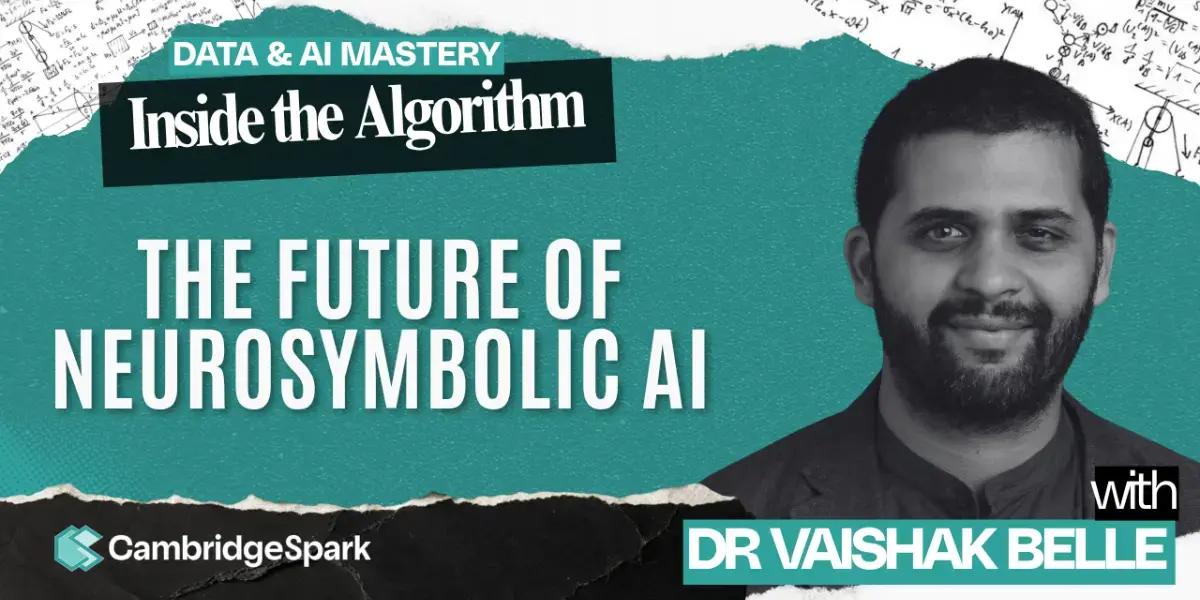
Dr Vaishak Belle thinks that answer is incomplete and possibly wrong.
Vaishak has spent 16 years working at the intersection of logic, probability and machine learning. He's a reader at the University of Edinburgh's School of Informatics, an Alan Turing Institute faculty fellow, and director of research and innovation at the Bayes Centre. In the latest episode of Inside the Algorithm, he makes the case that the industry's most persistent problem isn't a scale problem at all. It's a structure problem.
The Trouble With Learning Only From Correlation
Large language models don't hold a model of the world the way a person does. When Vaishak makes a judgement about tomorrow's weather in Edinburgh, he's drawing on years of lived experience, a glance out the window, and a sense of the season. A language model has none of that. It has patterns in text. Cloudy tends to precede rain. Sunny tends to precede warmth. String enough of these correlations together and the output looks like reasoning.
Most of the time, that's enough. Occasionally it produces something absurd, like a model advising someone to walk to the car wash rather than drive, because walking is what the training data suggests people do when a destination is close by. The model isn't confused about geography. It has no concept of geography, or of the fact that the entire point of the trip was to bring the car.
Vaishak is careful with his language here. This isn't hallucination in the sense of imagining an alternate world. It's confabulation, a model producing something statistically plausible that happens to be wrong, with no awareness that it's wrong. That distinction matters, because it points to a different kind of fix than simply training on more data.
What Neurosymbolic AI Actually Looks Like in Practice
The fix Vaishak has spent his career working towards is neurosymbolic AI: pairing a language model's fluency with a symbolic or mathematical layer that can verify, calculate, or reason precisely where correlation alone falls short.
This isn't a theoretical proposal. It's already how the best current tools work. When a coding assistant like Claude Code is asked to solve a problem, it isn't relying purely on linguistic pattern matching. It parses the request, produces a Python script or algebraic expression, and hands the precise computation to a system built for precision. The language model handles understanding. A different mechanism handles getting the answer right.
It's a large part of why AI-generated code has improved so dramatically while AI-generated prose has plateaued in reliability. Code has a clear, checkable standard of correctness. A missing semicolon breaks everything, and that failure is easy to catch. A slightly awkward sentence, by contrast, is often just a different sentence, not a wrong one. That asymmetry, Vaishak argues, is exactly why symbolic verification works so well for code and why the same principle needs to extend further.
Teaching Models to Model Each Other
One of the more striking parts of the conversation covers theory of mind, the capacity to reason about what another person knows, wants, or expects. It's the mechanism that lets two people coordinate without spelling out every detail, and it turns out to be one of the harder things to get a language model to do reliably as conversations get more complex.
Vaishak's team's approach mirrors the neurosymbolic pattern: let the language model understand the context and produce an algebraic representation of it, then hand that representation to a solver that can reason about it precisely before feeding the result back. It's the same underlying idea as the coding example, applied to a much harder problem.
Where This Leaves the Industry
None of this is an argument against large language models. It's an argument for pairing them with the right complementary systems, rather than assuming that enough scale will eventually get you there on its own. Vaishak is equally candid about what's at risk if the industry doesn't take this seriously, particularly for junior engineers who may never build the underlying skills that senior engineers are currently able to bootstrap with these tools.
It's a conversation worth sitting with, especially for anyone whose job depends on knowing where AI's reasoning actually comes from and where it doesn't.
______________________________________________
Chapter Markers:
-
(00:00) - Why LLM hallucinations happen
-
(02:12) - The biggest shift in AI over the last 16 years
-
(07:42) - How logic and probability shaped Vaishak's path into AI
-
(10:11) - Introducing neurosymbolic AI
-
(11:27) - Claude Code, algebraic delegation and the theory of mind problem
-
(20:01) - Theory of mind in robotics and human computer interaction
-
(21:54) - Confabulation versus hallucination
-
(26:42) - Why AI errors are not the same as human dishonesty
-
(27:24) - Reinforcement learning, reward signals and learned behaviour
-
(32:36) - Syntax checks and the engineering behind reliable code
-
(37:52) - What happens to the software engineer's role
-
(40:49) - Advice for early career AI thinkers
Useful Links:
If you're a data and AI leader looking to build deep technical capability across your organisation, Cambridge Spark is here to help - explore our AI solutions.