


The question organisations tend to ask about AI is whether the model works. Accuracy scores, benchmark results, proof-of-concept outputs. These are the metrics that get presented in steering committees and written into project proposals.
They are also, increasingly, the wrong place to focus.
Spend enough time with people who have actually shipped AI in complex environments, and a different set of questions starts to matter. Not only does it work in the notebook, but does it work when the world changes? Not what accuracy did we achieve, but who is going to use this, and have we spoken to them yet? Not how sophisticated is the model, but how quickly can we get something into production that is actually delivering value?
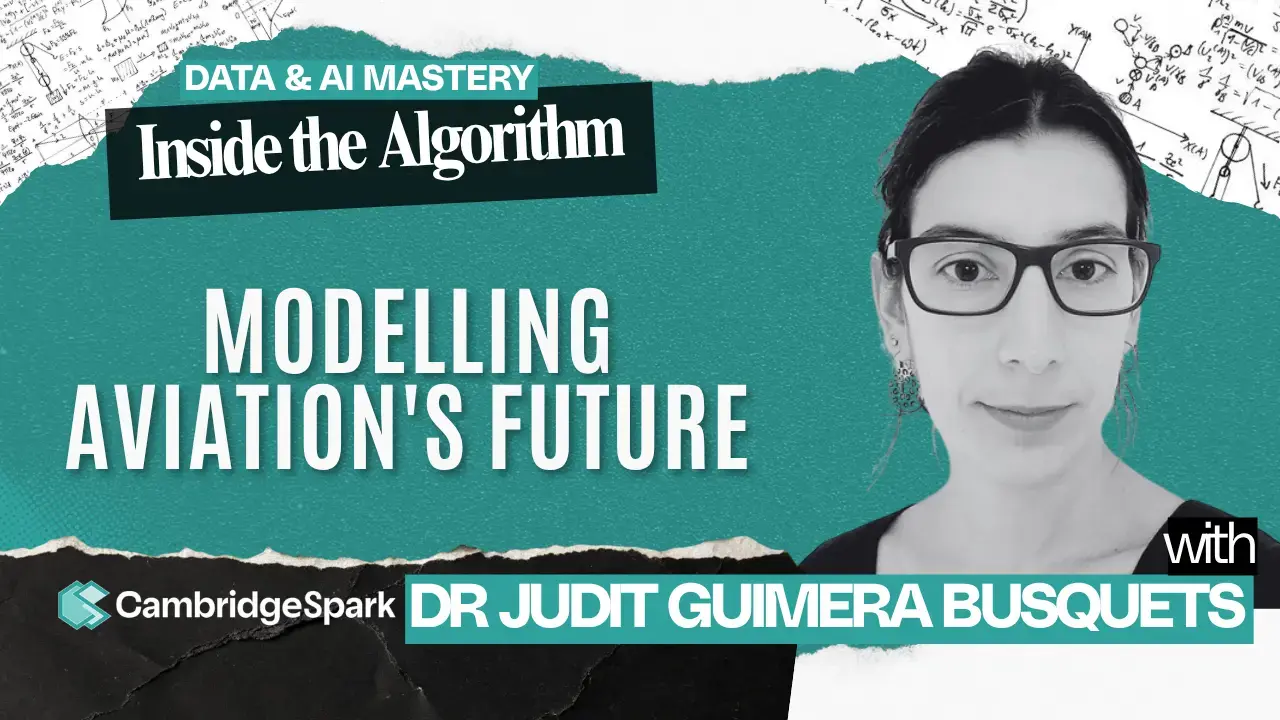
These are the questions running through the latest episode of Inside the Algorithm. Dr Judit Guimera Busquets, Head of Data Science at Datasparq, brings a perspective that spans academic rigour and hard-won consulting experience. The combination makes for a conversation that is as technically grounded as it is practically useful.
When the Network Is the Problem
Judit's PhD focused on forecasting air traffic network growth, and the framing she uses to describe it cuts to something fundamental about complex systems.
Most forecasting problems are self-contained. You model demand for a product, a route, or a service. The variables are bounded. But an air transport network is, in her words, a living system where everything is connected to everything else. Remove a single airport pair, and the effect cascades. Add a new route, and the whole topology shifts. The data you trained on no longer describes the world you are trying to predict.
This is not just an aviation problem. It is the condition that any model faces when it is deployed into a system that keeps changing. The challenge is not building a model that works once. It is building a framework that remains useful as the ground moves beneath it.
What Structural Shocks Actually Do
The pandemic is the stress test Judit returns to, and her analysis of it is precise. A shock of that scale does not just introduce noise into a model. It breaks the core assumption that historical correlations will hold. The relationship between household income and passenger demand, stable and well-evidenced across decades of research, simply stopped working. Overnight, almost.
The answer is not a better model. It is a better system. One with a human in the loop is able to adjust elasticities, introduce custom variables, run what-if scenarios, and exercise the kind of domain judgement that no statistical framework can replicate. The model is a tool. The expert using it is what makes it reliable.
This is a principle that extends well beyond aviation. Any AI system operating in a volatile environment needs mechanisms for human intervention. Not as a fallback for when things go wrong, but as a structural feature of how the system is designed.
Pragmatism Over Perfection
The second half of the conversation shifts to what great data science delivery actually looks like in practice, and Judit's views here are worth taking seriously.
The instinct to chase the highest possible accuracy is, she argues, often counterproductive in a business setting. An 80% model running in production inside three to four weeks creates more value than a 95% model that takes six months to build and never quite makes it out of the development environment. The goal is not the best model. It is the best outcome. Those are different targets, and conflating them is one of the most common reasons AI projects stall.
She is equally direct about adoption. The question of who will use an AI output, how it will be surfaced, and what form it needs to take is not a question for the end of a project. It is a question for week one. If the output lands in a folder nobody accesses, the technical quality of what is inside it is irrelevant.
The Conversation the Industry Is Not Having
Judit closes with the observation that matters most: AI governance, evaluation frameworks, and rigorous testing discipline are the least discussed and most consequential challenges facing applied AI right now. The tendency to reach for an agent, an LLM, a new capability, without thinking carefully about what happens to enterprise data or personal data inside those systems, is a risk that is accumulating quietly across the industry.
Unglamorous work. Important work. And, in her view, the place where serious practitioners need to focus their attention next.
______________________________________________
Inside the Algorithm is available on the Cambridge Spark YouTube channel and wherever you listen to podcasts.
Subscribe to Data & AI Mastery so you never miss an episode of Inside The Algorithm.
If you are a data and AI leader looking to build deep technical capability across your organisation, Cambridge Spark is here to help. Explore our programmes at cambridgespark.com.