


The question most organisations get wrong when deploying AI is not which technology to choose. It is whether they have defined a clear enough business problem before reaching for one at all.
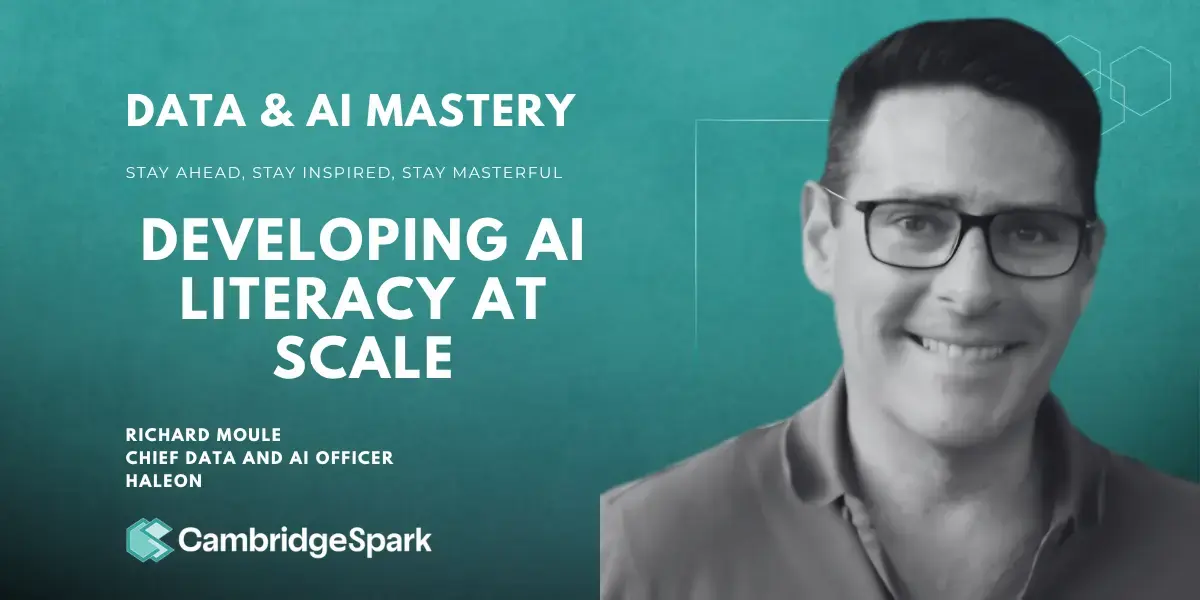
For Richard Moule, Chief Data and AI Officer at Haleon, the pattern is familiar. A business leader arrives with energy and intent, cites the latest term they have heard at a conference, and asks why the organisation is not doing it yet. Six months ago it was generative AI. Now it is agentic AI. The specific word changes. The underlying dynamic does not.
Richard's response is always the same. Tell me what you are trying to achieve. Let us work backwards from there.
The CDAO Who Starts With Education, Not Technology
Richard's route into his current role spans finance, retail, sports and consumer healthcare, with stops at EY and Reckitt along the way. The thread running through all of it, he argues, is consistent. Whether it was market research panel data in the early years or large language models today, the fundamental challenge has always been the same: how do you take information that is too large and complex for humans to process unaided and use it to make better decisions?
What has changed is the pace at which new labels get attached to that same challenge. And with each new label comes a fresh wave of pressure, internally and externally, to be seen to be doing whatever the latest term describes.
Richard's answer to that pressure is not resistance. It is education.
Starting at the Top
When Richard joined Haleon 18 months ago, AI literacy across the organisation was low. His first move was not to build a use case pipeline. It was to fix that problem, beginning with the people who mattered most.
Working with Cambridge Spark, Haleon invested in a structured, in-depth AI education programme aimed at its executive team and the layer directly beneath it. The brief from the CEO, Brian McNamara, was explicit: Haleon should be the best-educated leadership team in the FTSE 100 when it comes to AI.
That ambition has a practical logic behind it. Leaders who understand the technology, even at a conceptual level, stop asking for specific tools and start asking better questions. The conversation shifts from "are we doing agentic AI?" to "I am trying to achieve this outcome, and I think AI could play a role. Help me understand how." That is, as Richard puts it, a materially different conversation to have.
Raising the Floor and the Ceiling
Educating leadership buys time and credibility, but it does not remove the pressure to show progress. Richard uses a phrase that captures his approach precisely: raise the floor and raise the ceiling at the same time.
Raising the floor means doing the unglamorous foundational work. Master data management. Reducing technical debt. Building the data infrastructure that agentic systems will eventually depend on. None of it is visible to the rest of the business. All of it is necessary.
Raising the ceiling means giving people something to engage with in the meantime. Unstructured data is often the fastest route. Documentation, internal content, and areas where generative AI can deliver genuine value quickly and without requiring the foundational work to be complete. People feel progress. Momentum builds. The organisation does not stall while the harder problems are being solved in the background.
Where the Limits Are
Richard is equally clear about where AI falls short, at least for now. Processes that look long and complicated on paper often turn out, on closer inspection, to be built primarily on human negotiation. People deciding whether something is black, white or grey and finding a path through. AI can provide better data to inform those conversations. It cannot replace the judgement, the relationship, or the willingness to sit with ambiguity that makes them work.
That honesty about limitations is part of what makes Richard's broader case so credible. He is not selling AI as the answer to everything. He is making a disciplined argument for understanding what it is genuinely good at, building the conditions for it to work well, and resisting the pressure to move before the organisation is ready.
A thousand flowers may bloom. But without the discipline to tend them, Richard is fairly certain most of them will wilt.
______________________________________________
At Cambridge Spark, we work with organisations navigating exactly this challenge: building the data and AI capability, adoption strategy and leadership confidence to turn experimentation into lasting transformation. Explore how we can support your organisation at cambridgespark.com.