


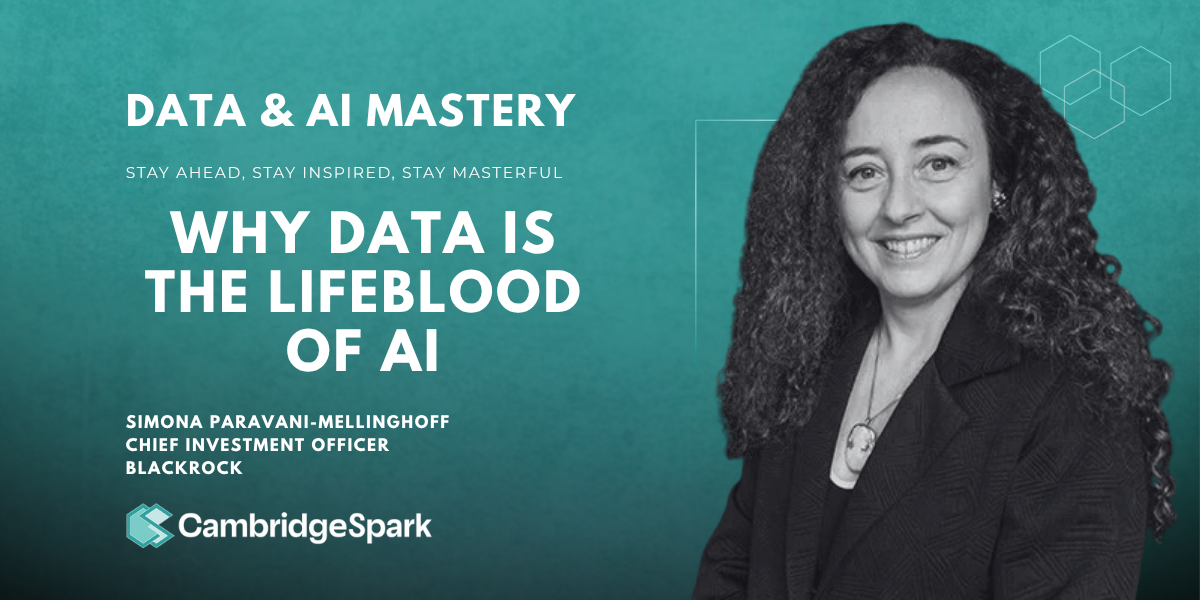
The instinct in most organisations right now is to reach for the biggest, newest model available and assume it is the right tool for the job. Simona Paravani-Mellinghoff, Chief Investment Officer at BlackRock, thinks that instinct is misplaced.
Her argument is not that frontier models lack value. It is that value depends entirely on matching the tool to the task and that matching exercise requires more discipline than most organisations currently apply.
Don't Use the Ferrari When a Fiat Punto Will Do
Simona's framing is memorable precisely because it resists the hype cycle. Frontier models, she argues, are extraordinary, orders of magnitude larger than anything she could have imagined as an undergraduate. But extraordinary does not mean universally appropriate. Her analogy: don't use a Ferrari when a Fiat Punto will do, because the two have very different running costs, and a Ferrari is no help at all on a road it wasn't built for.
The practical implication for data and AI leaders is straightforward but easy to ignore. Generative AI is one tool in a broader toolkit that still includes smaller, domain-specific machine learning models built for narrower, well-defined problems. The organisations getting this right are not the ones chasing the largest model available. They are the ones who have done the harder work of understanding which technique suits which task and who are honest about the fact that this understanding takes time and deliberate learning to build.
Relevant Data Beats More Data
Underneath the model selection question sits a more foundational one, and it is where Simona spends most of her attention. Overseeing hundreds of billions in mandates has taught her that the temptation to equate a large volume of data with valuable data is one of the more expensive mistakes an organisation can make.
Good data infrastructure, in her framing, rests on three qualities: accessibility, cleanliness and relevance. The third is the one most often overlooked. It is entirely possible to have enormous, well-governed datasets that fail to answer the specific question in front of you. At BlackRock, that discipline has enabled genuinely new capability, including sentiment analysis across central bank communications in multiple languages, and thematic investing built on identifying companies linked to a trend regardless of which sector they formally sit in. Neither of those capabilities is about efficiency for its own sake. Both are about sharper insight, which is the distinction she is most insistent on. The AI conversation in financial services, she argues, should not be reduced to cost and scale. It should be about the additional insight that well-chosen data and well-chosen models can surface for clients.
The Skills That Actually Transfer
Simona also offers a useful corrective to the current anxiety around AI and jobs. Most of the public debate, she points out, analyses tasks in isolation and asks whether a given task could be automated. That framing misses how jobs actually work. A role is a bundle of tasks, often intertwined in ways that resist clean separation, and the economics of automating any single task do not always make substitution worthwhile.
Rather than trying to predict which jobs will disappear, she suggests focusing on the skill set that holds up regardless of how the technology evolves. She describes it as a pyramid. At the base sits the ability to work effectively with AI systems, a skill that is trainable through repetition. Above that sits critical thinking, the capacity to interrogate a model's output rather than accept it, which becomes more important precisely as models become more capable and more pervasive. At the top sits creative thinking, the willingness to reimagine a process entirely rather than simply speeding up the existing one. It is also, she notes, the hardest of the three to teach and the one children tend to do more naturally than adults.
Why This Matters Beyond Financial Services
Simona's convictions here are not purely professional. Her passion for financial inclusion and education stems from her own path, as the first in her family to attend university, supported by a scholarship she has since paid forward through her own giving. That same instinct shapes her view on AI and financial inclusion: used well, these tools can extend financial advice and financial literacy to people who have historically lacked access to either.
The throughline across investment infrastructure, model selection and workforce skills is the same. Bigger is not automatically better. Relevance, judgement and the discipline to match the right tool to the right problem are what separate lasting value from expensive noise.
At Cambridge Spark, we work with organisations navigating exactly this challenge, building the data literacy, AI capability and leadership judgement needed to turn access to powerful models into genuinely better decisions. Explore how we can support your organisation at cambridgespark.com.
______________________________________________
Chapter Markers:
- (00:00) - Introduction: no data, no AI party
- (01:16) - Simona's journey from Italy to global CIO
- (03:40) - What academia and industry learn from each other
- (05:21) - Building good data infrastructure at scale
- (08:56) - Frontier models vs specialised models: the Ferrari and Fiat Punto analogy
- (11:42) - Why education and scholarships matter to Simona
- (15:03) - The three-layer skill pyramid for the AI era
- (17:19) - Will AI threaten jobs or create new ones
- (21:04) - AI's role in advancing financial inclusion
- (23:22) - Advice for the next generation
- (24:06) - Quickfire round
- (27:22) - Closing thoughts and key takeaways
Useful Links:
If you're a data and AI leader looking to build deep technical capability across your organisation, Cambridge Spark is here to help - explore our AI solutions.