



A pressure ulcer is an injury to the skin and the tissue beneath it, and the patients most likely to develop one are those confined to a bed or a chair. When the pressure ulcer team at University Hospitals Birmingham went through its reports by hand and charted what was causing these injuries, they found something surprising. Repositioning – the routine turning of people who cannot move on their own – came out on top. Skin inspection was second, and risk assessment came fifth.
The team then checked which of those causes the trust was measuring. “The Waterlow score was the only thing we had a KPI for,” Justin King, UHB’s deputy head of clinical governance, told the HSJ Patient Safety Congress in Telford in September. Waterlow is a risk assessment tool, so the only cause with a target was the least common of the five.
Repositioning was already recorded in the trust’s electronic patient record, so it became a measure without need for an in-depth audit, and improvement work could begin from a baseline.
The NHS has spent two decades trying to turn the incident reports it collects into a picture of where harm will come from. Hospitals are buying software to make reporting faster and starting to point AI at the results. On the evidence presented in Telford, the paperwork is getting quicker but the trusts said it would take months to know whether patients were any safer. UHB’s improvement work began when its own specialists compared the most common harms on its wards with the ones it was measuring. That took time and the skill to interpret data, and the congress heard that the NHS is short of both.
Counting past harm
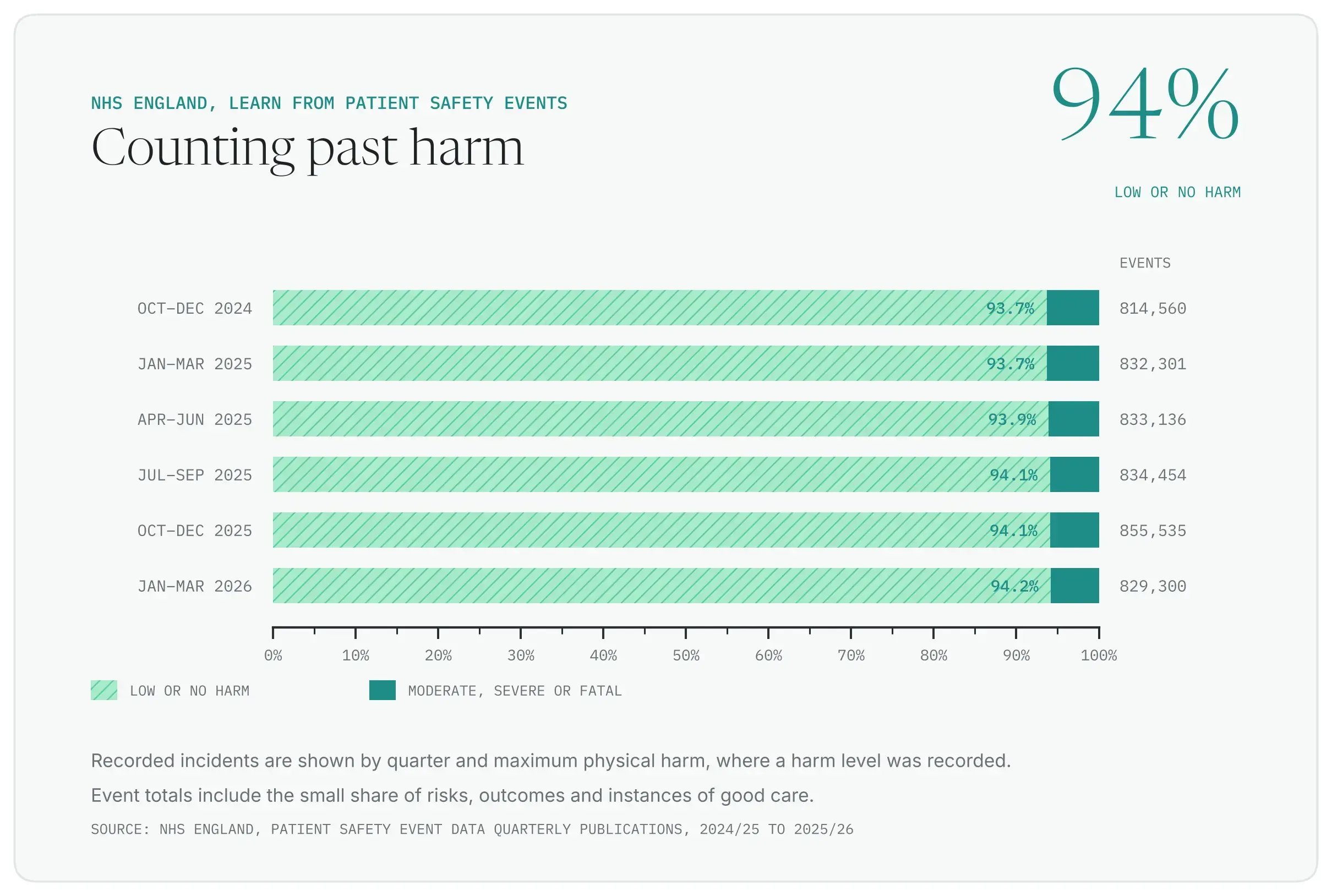
Trusts now file almost 9,000 incidents a day to the Learn from Patient Safety Events (LFPSE) service, which replaced the National Reporting and Learning System. Between January and March 2026, NHS England received 804,069 incident reports, and 94.2 per cent were graded as low or no physical harm. Its statisticians caution against reading much into the total. The count measures what staff write down, they say, and its rise in recent years probably reflects a healthier recording culture.
What the NHS does with those reports is an older problem. A 2013 Health Foundation report found that the service excelled at measuring what had already gone wrong, such as falls and hospital-acquired infections, while doing far less to track where the next failure might come from.
Suzette Woodward, a former director at the National Patient Safety Agency, has written that its incident system soon received more submissions than anyone could analyse, and that trusts’ reporting rates came to be treated as a league table.
Since September 2023, trusts have also worked under the Patient Safety Incident Response Framework (PSIRF), which lets each organisation choose where to investigate in depth. Suppliers including Radar Healthcare and RLDatix compete to automate what happens after an incident is filed.
Taking out the paperwork
UHB has been under scrutiny over its patient safety culture since 2022, when a BBC investigation led the local integrated care board to order reviews of the trust. In 2024, the Care Quality Commission served a warning notice over governance at its Good Hope Hospital.
UHB handles more than 70,000 incidents a year, King said, and transferring its pressure ulcer reporting into Radar’s software took more than two years. Before that, the tissue viability team – its specialists in preventing these injuries – would usually have “someone sat at a desk in front of a spreadsheet” on any given day, and hundreds of Word documents a quarter went out to wards and came back to be logged in Excel. Now a serious case sends an electronic form straight to the area’s manager, and the reminders and dashboards can run on their own.
“If you’re doing it the same every time, then it probably shouldn’t be a human doing it,” he said.
At Mid Yorkshire Teaching NHS Trust, recording a single incident on the old system took around 20 minutes, said Ahmed Hans, its patient safety intelligence manager. “We shouldn’t be surprised when we get disengagement from staff.” Since the switch to Radar in late 2025, employees log in through NHS Mail and an NHS number fills in the patient’s details. Ward managers who used to wait a month for their data can now see it as soon as a form goes in.
Hans put the saving at five or 10 minutes a report, across thousands of events and more than 10,000 people, and argued that the time goes back to patient care.
Both trusts have also cut their forms back. King tests any new box a colleague wants with one question: what will they do if it shows a particular result? “It’s surprising how few of the fields lead to a specific action,” he said. Mid Yorkshire stripped its template to the national LFPSE dataset plus six or seven local questions, after its old system had grown to hundreds.
Months from an answer
A delegate asked from the floor whether any of this had left fewer patients with pressure ulcers: after all the talk of richer data, where were “the tangible benefits”?
Repositioning rates had improved since the new process began, King said, but the change was “not showing up yet” in the trust’s pressure ulcer figures. Getting the tissue viability team out from behind its spreadsheets was worth a lot on its own, he added. Mid Yorkshire, two months into its dashboard, needed longer to judge the effect, Hans said.
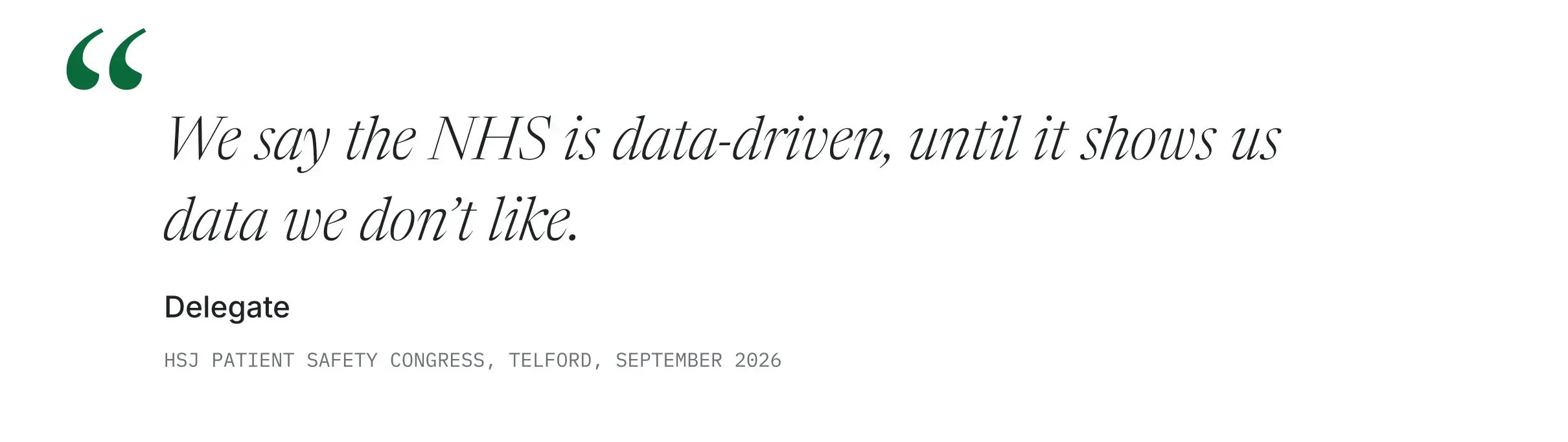
“We say the NHS is data-driven, until it shows us data we don’t like,” another delegate said, and asked whether dashboards were making staff more inquisitive or provoking pushback.
At Mid Yorkshire, one early effect has seen ward managers going back to the original forms when the dashboard shows something different from what was reported, Hans concluded.
Where AI fits
Both trusts see AI as the next step, but so far its role is modest. UHB’s Power BI dashboards include a Microsoft Copilot panel, but as far as King knew it reads only the numbers, so staff copy free text into it by hand. Radar are building large language models into their system to remove that manual stage, he said.
The trusts expect AI to help most with written accounts. UHB once tried to turn everything into drop-downs and now prefers free text, King said, because years of coding learning responses by cause had produced a chart that “doesn’t really give you the information that you need”. Version 6 of LFPSE currently asks organisations to paste in what their reviews found, word for word, so it can be mined. Hans proposed a narrower use, in which AI prompts a member of staff whose description of an incident contradicts the level of harm they have entered, before the report is submitted.
Chatbots are already changing what arrives in hospital inboxes. King said the trust now receives a large number of complaints of up to 10 pages, written with the help of AI, which read well but make it harder to find what matters to the patient or family. Rhian Bulmer, chief customer officer at Radar Healthcare, who chaired the session, said the replies were starting to come back the same way. “We’ve almost industrialised something that is designed to be simpler,” she said.
A delegate then asked how teams could be sure AI interpretation added anything, when much of what the analysis found was already known, and whether letting AI design solutions would erode staff curiosity. The reply from the stage was that AI applied to a bad process only makes it faster, and that a trust should settle who is responsible for the data before adopting it.
In September, a national commission set up by the Medicines and Healthcare products Regulatory Agency found that clinicians and the public usually did not know its Yellow Card scheme covers medical devices, and recommended a stronger culture of reporting problems with AI. It also warned that responsibility for AI errors tends to fall on the staff closest to the patient.
Time on the wards
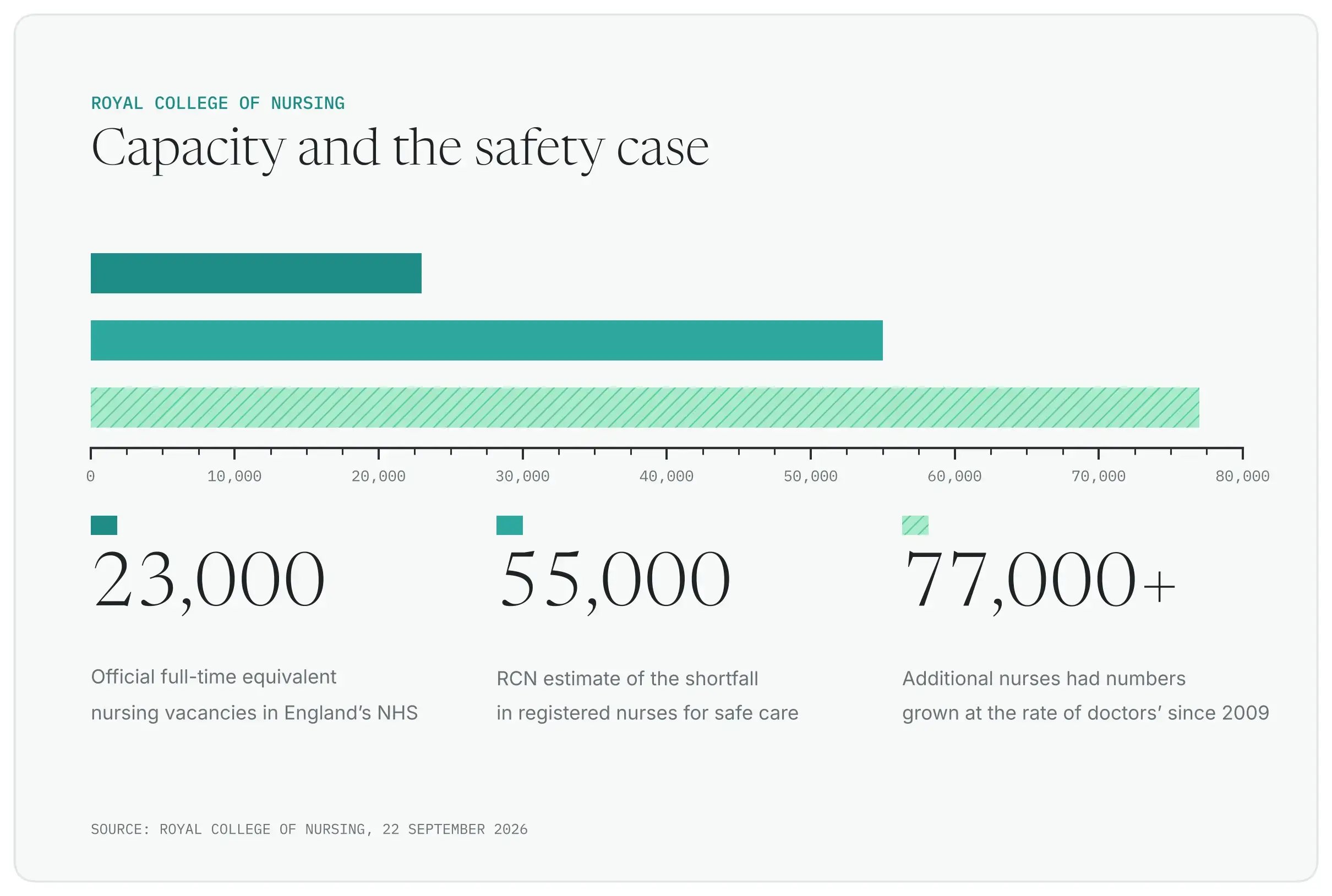
The staff closest to the patient are short of time, and Lynn Woolsey, chief nursing officer at the Royal College of Nursing, used her keynote to argue that staffing is a safety issue in its own right. England’s NHS has 23,000 official full-time equivalent vacancies in nursing, and RCN analysis puts the shortfall for safe care at 55,000 registered nurses. Had their numbers grown at the rate of doctors’ since 2009, she said, the workforce would be more than 77,000 larger.
If every trust saved what Mid Yorkshire estimates – five or 10 minutes on each of the almost 9,000 incidents reported each day – the NHS would get back between 750 and 1,500 hours a day. Over a seven-day week, that is the contracted hours of 140 to 280 full-time staff.
The people in the room
Upstairs, in the congress’s Safety Leaders Exchange, we asked senior NHS staff what stands in the way of progress. Our two roundtables put it as a question about technology: what is the biggest barrier to turning NHS data into insight that protects patients?
Participants described colleagues reluctant to look at data, clinicians who reject unwelcome findings, a shortage of people who can interpret the numbers and BI teams that can take months to return them. Interpretation recurred throughout: staff receive large volumes of information with no narrative attached, and specialists are over-relied on. Psychological safety was raised too, as was the gatekeeping of records by integrated care boards and other bodies.
Most of what trusts collect looks backwards, participants said, and they need more predictive analytics – partly to save money. They also asked which data improves patient safety in the first place.
A study of culture and behaviour in the NHS led by Mary Dixon-Woods – now director of THIS Institute at the University of Cambridge – found organisations putting considerable effort into collecting data and struggling to obtain valid insight into the quality of the care they provided.
A company that sells training, as we do, has a natural interest in concluding that interpretation is the scarce skill. Yet our roundtables kept returning to it all the same, and UHB’s change of course came from its specialists reading their figures.
Back in the Radar session, King had given the room a date: “Not yet, unfortunately, but quite happy for you to email me in six to 12 months and we’ll see.” UHB will be well positioned to answer, because it measured repositioning before anything changed.
We sponsored two roundtables at the congress, moderated by Tilly Allen, our NHS and public sector accounts director, and the Advancing Patient Safety with Data and Analytics award, which she judged. We provide data and AI training to NHS organisations. Radar Healthcare, who sell incident management software, were the event’s headline partner and ran the session reported here. Roundtable contributions are unattributed.