




Workplace learning is entering a new phase.
For a long time, many organisations have relied heavily on formal learning models that are often delivered separately from the day-to-day realities of work: a course to complete, a platform to log into, a programme to attend. But that model is under pressure. Skills needs are changing faster, digital capability matters more broadly across the workforce, and the gap between learning and doing is becoming harder to defend. Learning at Work Week 2026 reflects that shift with its theme, Many ways to learn, which highlights everything from coaching and shadowing to social learning, online resources, and formal development.
That wider context matters because the capability challenge is no longer theoretical. The urgency is clear. McKinsey’s 2025 State of AI found that 78% of respondents say their organisations now use AI in at least one business function, with 71% regularly using generative AI in at least one function. At the same time, the World Economic Forum estimates that 39% of workers’ core skills will change by 2030.
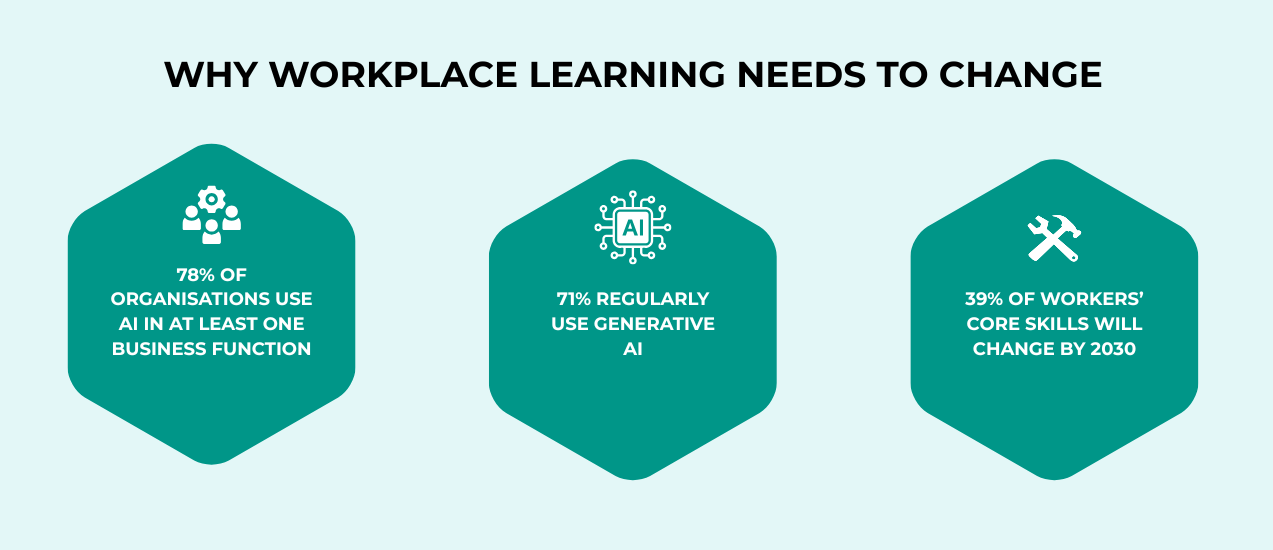
Those two signals point to the same conclusion: organisations do not just need more learning. They need learning that helps people adapt to changing work, build confidence through practice, and apply new capabilities in real settings. The future of workplace learning will be practical, applied, and built for change.
Learning That Lives Too Far From Work No Longer Works
Formal learning still matters. Structured teaching, expert input, and well-designed programmes all have an important role to play. But on their own, they are often not enough to build capability in fast-moving areas such as data, digital, and AI.
That is because people rarely build confidence in these areas through passive exposure alone. They build it by solving problems, testing ideas, applying tools, getting feedback, and improving over time. The organisations making the most progress are not simply delivering more content. They are thinking more carefully about how learning connects to real tasks, real workflows, and real business priorities.
The clearest examples of this shift can be seen in practice. Explore our case studies to see how organisations are building capability in real-world settings.
This is one reason the wider learning ecosystem matters so much now. This is one reason the wider learning ecosystem matters so much now. The question is no longer just whether organisations offer training. It is whether they create the right mix of structured learning, applied practice, feedback and on-the-job application to build meaningful capability.
That is the thinking behind Cambridge Spark’s approach: helping organisations build data and AI capability through learning that is practical, relevant and connected to real work.
Digital Skills Are No Longer Just for Digital Teams
Another important shift is that digital capability is no longer confined to specialist roles. McKinsey’s 2025 article We’re all techies now argues that digital upskilling is no longer just for tech teams and can help all employees thrive and make companies more competitive.
That has major implications for workplace learning. In many organisations, digital and data fluency are becoming baseline capabilities rather than niche expertise. Employees are increasingly expected to work with data, evaluate outputs from intelligent tools, adapt to new workflows, and make sound decisions in more technology-rich environments. Learning strategies, therefore, need to support a much broader population of learners, with routes that are accessible, relevant, and embedded in work.
That changes the brief for learning. The most useful learning experiences will not just transfer knowledge. They will help people become more adaptable, more confident in ambiguity, and better able to keep learning as work evolves.
This is where applied, work-based routes remain highly relevant. At Cambridge Spark, we support this through a range of programmes designed to help organisations build data and AI capability through learning that is connected to real work, role performance and business outcomes. That includes apprenticeships, apprenticeship units and education programmes.
From Content Delivery to Capability Design
The organisations that respond best to this moment are unlikely to be the ones with the most content. They are more likely to be the ones who understand how capability is actually built.
- That means asking tougher questions:
- Are people practising, or mainly consuming?
- Is learning connected to real work, or sitting beside it?
- Are managers part of capability-building, or is learning treated as someone else’s responsibility?
- Are we measuring completion, or application and impact?
The future of workplace learning will belong to organisations that move beyond content delivery and start designing for capability, confidence, and change.
Final Thought
Workplace learning is not becoming less important. It is becoming more consequential.
At Cambridge Spark, we’re responding to that challenge by designing programmes that connect learning directly to real work. Through our programmes, we help organisations build data and AI capability in ways that are applied, measurable and aligned to business needs, ensuring learning supports performance, progression and long-term capability-building.
Explore our Learning at Work Week 2026 page to discover webinars, insights and more on many ways to learn in the age of data and AI.