


When organisations talk about data transformation, the conversation often starts with platforms, architecture, and tooling.
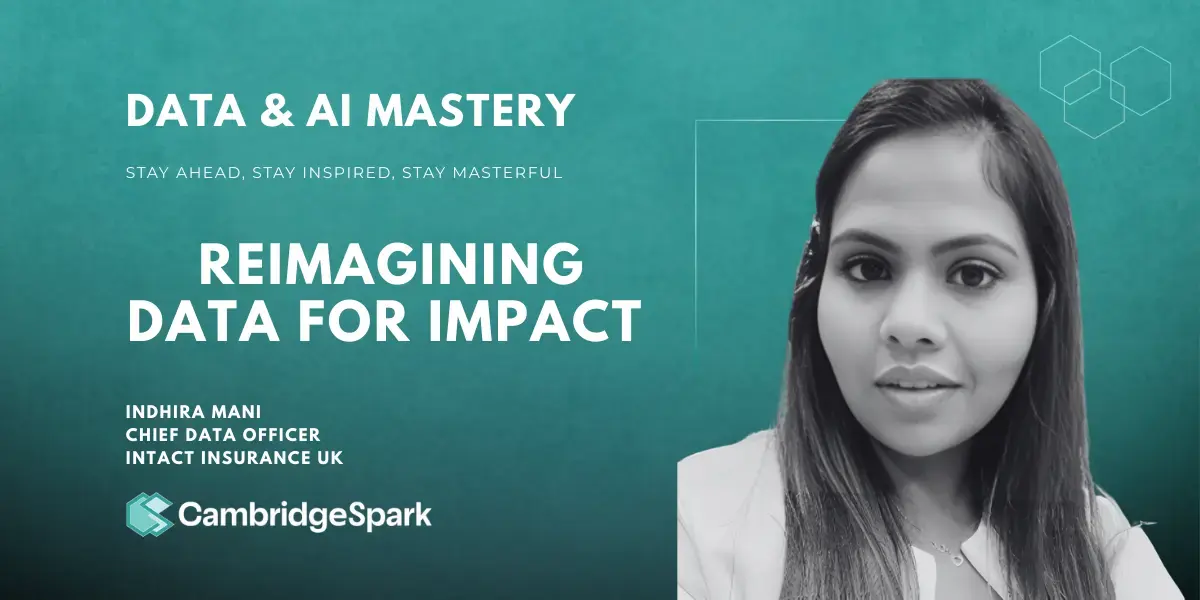
For Indhira Mani, Chief Data Officer at Intact Insurance UK, that’s the wrong starting point.
In her conversation with Dr. Raoul-Gabriel Urma on Data & AI Mastery, Indhira shares a powerful perspective: true transformation begins not with technology but with people.From Back Office to Strategic Lever
Insurance is, at its core, a risk business. Success depends on making better decisions, faster and smarter, for brokers and customers alike.
When Indhira stepped into her role, the mission wasn’t simply to modernise legacy systems. It was to reimagine how people, data, technology, and decisions come together to serve the organisation’s strategic ambitions.
The starting point? A business rich in data, but constrained by silos. Data was often viewed as a back-office function rather than a strategic driver of transformation.
Changing that perception required more than new dashboards. It required cultural shift.
Winning Hearts and Minds
“People make business.”
That belief underpins Indhira’s approach.
Rather than building an ivory tower data function, she focused on creating cross-functional squads, embedding data translators into underwriting, pricing, and claims teams. The goal was simple: co-create agile data products that deliver measurable impact, not static reports that gather dust.
This wasn’t easy.
Cultural change rarely is. It meant bridging the gap between what she describes as “two different floors,” where data teams and business strategy had historically operated in isolation.
It required education. Relationship-building. Trust. Patience.
And above all, executive sponsorship.
When the CEO describes data as “the lifeblood” of the organisation, it changes the tone of the conversation. Top-down commitment creates space for bottom-up curiosity to flourish.
Simplicity and Adoption as North Stars
One of the most refreshing insights from the episode is Indhira’s definition of success.
In twelve months’ time, she doesn’t want teams talking about stewardship frameworks or metadata management tools. She wants the business to say:
“Can you do more of that?”
Success, in her view, is being able to tell a simple data story that clearly shows tangible value.
Too often, data teams overwhelm users with complexity. More dashboards. More metrics. More data.
But more data doesn’t necessarily mean better decisions.
In fact, it can lead to decision paralysis.
The real goal is delivering the right data, at the right time, to the right people, in a way that enables faster, more informed decisions.
That’s where transformation becomes visible.
Balancing Simplicity with Compliance
Operating in insurance means navigating regulation, governance, and ethical considerations.
But Indhira doesn’t see compliance and innovation as opposing forces. She views them as part of the same agenda.
Her aim isn’t to make data “perfect.” It’s to make it usable, responsibly.
That distinction matters.
Perfection can paralyse progress. Usability, delivered within regulatory guardrails, drives momentum.
It’s about thinking long term. Building data not just for the next dashboard, but for the future direction of the organisation.
The Commercial Impact of Data
Beyond cultural change, Indhira’s transformation has delivered measurable business outcomes.
Cost efficiency is one lever. But equally important is creating competitive advantage, enabling smarter underwriting, more informed pricing, and better risk selection.
In simple terms, better data means:
- More submissions
- More quotes
- More policies
- More premium
- More profit
That offensive strategy, not just defensive cost control, marks the shift from data as support function to data as growth engine.
A Contrarian View on Centralisation
In an industry often obsessed with scaling and centralising everything, Indhira takes a pragmatic stance.
Not all data needs to be centralised. Not everything must be controlled from the centre.
Adoption matters more than architecture purity.
Federation, when appropriate, can empower teams without sacrificing oversight. Over-centralisation, on the other hand, can slow progress and create unnecessary friction.
And giving everyone access to everything? That’s not empowerment. That’s chaos.
Pragmatism beats dogma.
AI: Augmentation, Not Replacement
Looking ahead, Indhira is excited by AI, not as a replacement for people, but as an amplifier of human intelligence.
For her, the opportunity lies in using AI to achieve the same goals, only smarter and faster.
The workforce of tomorrow isn’t about humans versus machines. It’s about humans working alongside AI to make better decisions without fatigue or bias.
That mindset keeps the focus where it belongs: on outcomes.
The Leadership Mindset That Makes It Possible
Throughout the conversation, one trait stands out: curiosity.
Indhira credits peer learning, networking, and constant openness to new perspectives as critical to staying relevant in a fast-moving industry.
Transformation isn’t a one-year programme. It’s a continuous journey.
And like any journey, it requires resilience, humility, and a willingness to learn.
Final Reflection
Data transformation doesn’t begin with platforms.
It begins with people.
Win hearts and minds. Tell simple stories. Deliver tangible value. Stay pragmatic. Stay curious.
Technology enables change, but people make it real.
At Cambridge Spark, we help organisations build the data and AI capabilities that drive both cultural and commercial transformation, combining technical depth with leadership, adoption, and measurable impact.
👉 Explore how we support data and AI transformation