


Most conversations about AI ROI start in the same place: cost reduction. How many roles can we consolidate? How much can we save? What does the headcount model look like in three years?
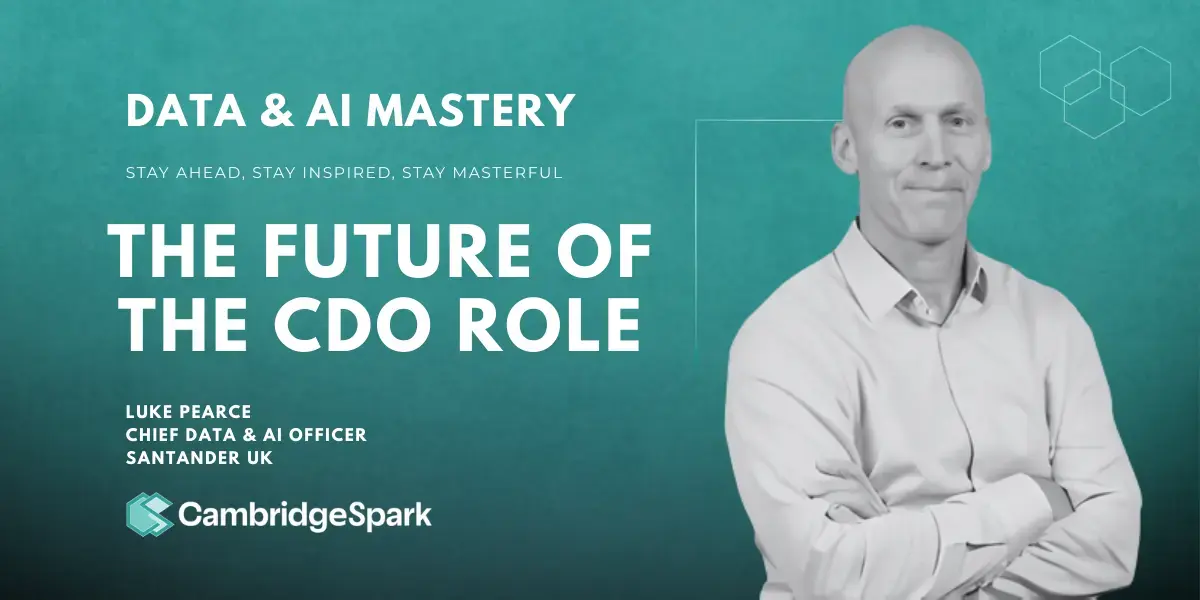
For Luke Pearce, Chief Data and AI Officer at Santander UK, that framing is not just incomplete. It is the wrong question entirely.
In his conversation with Dr. Raoul-Gabriel Urma on Data and AI Mastery, Luke offers a perspective shaped by a genuinely unusual career. Japanese and economics at university. Graduate training at Capgemini building front-end systems. Stints in manufacturing and Corrective Services in Australia. Four years at Commonwealth Bank. Fifteen years at Barclays. And now, three years as CDO at one of the UK's largest retail banks.
That breadth matters. It is what gives Luke the confidence to say, with real conviction, that banking is not the whole world. And that data becomes most powerful when it reflects the full complexity of a customer's life, not just their transactions.
The FOMO Problem in Banking
There is a version of the AI story that plays out in almost every large organisation right now. The board wants to see progress. The C-suite feels the pressure. Use cases multiply. Pilots launch. And somehow, the value never quite arrives.
Luke recognises this pattern, and he has a clear view on why it happens. In heavily regulated industries like financial services, the instinct is to govern first and enable second. Data gets locked down. Creativity gets squeezed out. And organisations end up with excellent controls over data that is not actually doing very much.
The conversation at Santander, Luke explains, has been different. Right from the CEO down, the invitation has been explicit: show us what more the data can do. That kind of sponsorship changes everything. It shifts the energy from risk management as a blocker to risk management as an enabler. It gives teams permission to experiment. And it creates the conditions where genuine innovation becomes possible.
Redefining the North Star
So if cost reduction is the wrong primary measure, what is the right one?
Luke's answer is customer delight and colleague experience, held in balance. Not as soft metrics, but as the primary drivers of a balanced scorecard that happen to produce cost savings as a byproduct.
The logic is compelling. When AI reduces the time it takes to complete a customer journey from three weeks to less than a day, that is a customer outcome worth measuring in its own right. When colleagues stop drowning in low-value admin and start doing work that actually requires their expertise, that shows up in productivity and engagement long before it shows up in a headcount model.
The cost of takeout follows. But if you chase it directly, Luke argues, you tend to pick the wrong use cases, lose the support of the people you need most, and undermine the broader transformation before it has a chance to land.
Building AI That Actually Sticks
One of the most practical ideas in the conversation is how Santander structured its approach to AI deployment. Rather than generating a list of hundreds of potential use cases and then trying to prioritise across them, the team chose a domain-based model. Four domains. Cross-functional teams combining business, architecture, technology, data science, and engineering. A shared roadmap built together from the start.
The result was not a cleaner spreadsheet. It was genuine organisational alignment. Teams that understood the regulation, the operation, and the model. People who felt ownership over the outcomes, not just the inputs.
Luke is refreshingly honest about the messiness of the process. Some use cases that looked promising failed within the first week. Others that seemed modest turned into the organisation's most widely adopted AI tools. The knowledge base that started as a contact centre resource now serves colleagues across the business in ways no one fully anticipated at the outset.
That willingness to stay curious and treat failure as data rather than embarrassment is, Luke suggests, one of the most important cultural ingredients of a successful AI programme.
The Contrarian View Worth Taking Seriously
Perhaps the most striking moment in the conversation comes in the quickfire round, when Luke is asked for a contrarian industry view. His answer is direct: the CDO role is shrinking. As AI literacy spreads across organisations and models take on more of the oversight and orchestration work, the need for a centralised data function diminishes. In ten years, he expects AI capability to be embedded so deeply into everyday business roles that the idea of a separate data leader will feel as dated as a dedicated digital director did a decade ago.
It is a bold position for a sitting CDO to take. But it is also consistent with everything else Luke says. The goal was never to build an empire. The goal was to make data and AI so useful, so trusted, and so embedded that they no longer need a separate champion.
That is what genuine transformation looks like.
At Cambridge Spark, we help organisations build the data and AI capabilities that make transformations like this possible, combining technical depth with leadership development, adoption strategy, and measurable business impact.
👉 Explore how we support data and AI transformation